
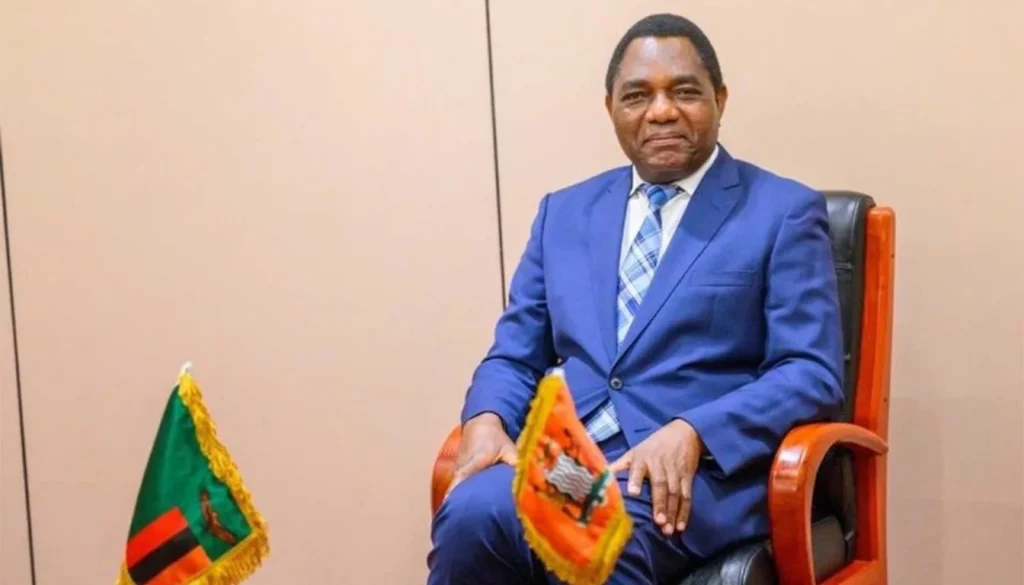
Zambian President Hakainde Hichilema has emerged victorious in securing a second five-year term, after winning 61.4% of the votes, giving him the mandate to implement an economic development program through investments focusing on copper production and restructuring of debt.
The Zambia Electoral Commission has announced the victory of the 64-year-old president on Thursday morning, August 18, after Hichilema garnered almost 2.97 million votes. His closest rival, who represented the opposition party, is Brian Mundubile and has won 38%, or 1.86 million votes.
Hakainde Hichilema secures his second term amidst the effort of Zambia in trying to convert macroeconomic stability into increased household income and investments.
Hichilema Campaigns on Growth of Economy
Hichilema was inaugurated in 2021 when Zambia was struggling with the aftermath of its sovereign default in 2020.
The regime later restored relationships with lenders, successfully implemented a $1.7 billion program with the IMF, and achieved considerable success in reorganizing the roughly $13 billion of foreign debt.
The economy has been growing by about 5% every year under Hichilema’s leadership. The inflation rate declined from 24.6% in 2021 to 6.5% in July 2026.
Furthermore, the country witnessed growth in copper mining. Zambia mined 890,346 tons of copper in 2025, its highest annual output since 1964 when the country gained independence.
Zambia Plans to Produce 3 Million Tons of Copper
The mining sector is expected to take a central place in Hichilema’s second-term economic policy.
The country is the second-largest producer of copper in Africa after the Democratic Republic of Congo and aims to increase annual production up to 3 million tons of copper by 2031.
The following companies have been investing in the mineral sector of the country, including: First Quantum Minerals, Barrick Mining, JCHX Mining Management (China), International Resources Holding and KoBold Metals.
It has sought to attract more investments by enhancing regulatory certainty and rekindling mining projects as the world’s demand for copper and other minerals grows.
Power and Infrastructure May Hinder Mining Expansion
To reach the 3-million tonne objective will involve huge investment beyond building new mines.
Industry experts say that Zambia may require an additional 2,000 MW electricity generation capacity to accommodate its expansion.
They want improvements in exploration incentives, mineral processing and mineral transport infrastructure.
At stake is the importance of mining, which accounts for about 70% of the country’s foreign earnings and well over 10% of GDP.
Economists have pointed out that Zambia must look beyond just expanding copper production and work to increase mineral processing in Zambia.
US-China Strategic Rivalry Over Minerals
The country’s copper deposits mean that it is right at the heart of the US-China strategic rivalry over minerals.
Chinese firms are heavily invested in the country’s mining sector, whereas Washington seeks a bigger share in Africa’s minerals value chain.
The relationship between Zambia and the US has been rocky this year after Lusaka complained about linking the proposed $2 billion health assistance arrangement with a critical minerals agreement.
Zambian authorities have stated that discussions on the health program should be separate from the minerals program.
Elections Raise Concerns over Political Freedoms
While Hichilema won by a convincing margin, there were concerns raised by the elections.
The opposition parties and civil society organizations claimed that there was manipulation of the process through restrictions on political freedom. The government dismissed these claims.
According to the EU election observation mission, the voting process was peaceful and competitive, although there were restrictions on basic freedoms and inequalities of campaigning conditions.
There were suspensions of vote counting due to the attacks against the election officials and theft of ballots.
There were arrests of opposition leaders after the overnight raids, where the government accused them of participating in a plot to overthrow the regime.
Stay Updated on Zambia’s Election Turmoil and Regional Impact
Could Zambia’s Election Dispute Escalate?
Check out the latest tensions as opposition claims victory amid a disputed vote count.
Who Will Lead Zambia After Voting?
Find the latest 2026 election updates as Hichilema and opposition leaders await results.
How Could Zambia’s Election Reshape Africa?
Uncover how the election could affect copper, China relations, and Africa’s wider economy.
When Will Nigeria’s 2027 Campaign Begin?
Track down how Tinubu’s campaign season is taking shape ahead of Nigeria’s 2027 election.
Why Is UN Alarmed Over Zambia?
Reveal why the UN is raising concerns over opposition arrests following Zambia’s disputed election.
Delivering Wider Economic Growth for Hichilema Is the Next Test
The president’s next term will be a litmus test of whether Zambia can translate its economic stability into higher living standards.
Copper earnings, reduced inflation, and successful debt restructuring have provided economic stability in Zambia; however, poverty and the high cost of living remain major problems.
Hichilema’s administration wants to seek a fresh IMF program by 2026, along with more investments in the mining, energy, and agriculture sectors.
